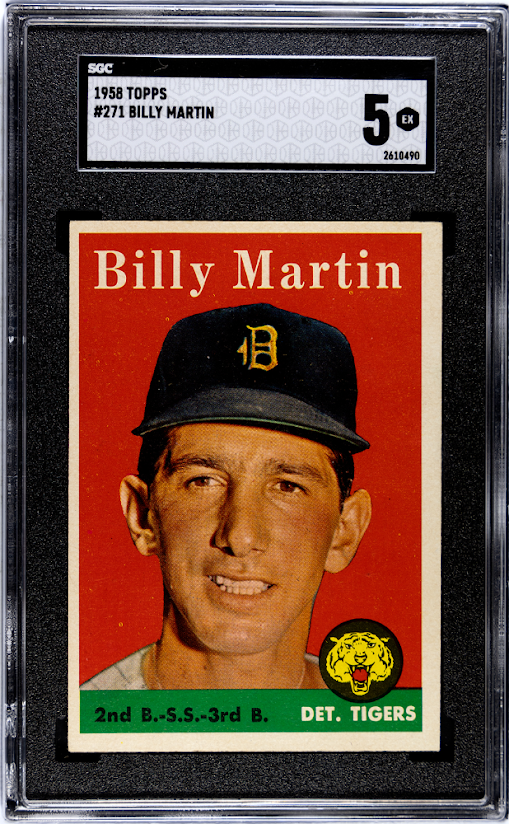
You've seen the listings. "PSA 9 — $180." Raw copy of the same card: $22. And you're thinking, what on earth is going on, and who decided a piece of plastic adds $158 of value to a rectangle of cardboard?
I asked the same question. Then I spent a considerable amount of money learning the answer the hard way, submitting cards before I fully understood what I was doing or whether the math made any sense. It did not always make sense. I am sharing this information so that your learning curve is cheaper than mine was.
The answer, by the way, is that grading companies aren't selling a number. They're selling certainty — and in a hobby full of sellers describing beat-up cards as "near mint," certainty turns out to be worth quite a lot.
What Grading Actually Is
When you submit a card, a professional examiner looks at it under magnification and scores four things: centering, corners, edges, and surface. Those scores combine into a grade on a 1–10 scale. The card gets sealed into a tamper-evident plastic case — a "slab" — with the grade printed on it and a certification number registered in a public database.
That slab does two things. It protects the card permanently. And it makes the grade verifiable by anyone, anywhere. A buyer in California can look up the cert number on PSA's website and confirm exactly what they're getting before they pay. No guessing, no trusting a stranger's optimistic description. That's the value proposition, and it's a legitimate one.
PSA — Professional Sports Authenticator
PSA is the dominant grading company and has been since the 1990s. When most collectors talk about a graded card, they mean PSA. Their grades carry the highest market premium — especially at PSA 10 — because they have the largest collector base, the deepest auction history, and the brand recognition. Right or wrong, PSA 10 is the benchmark the market uses, and the market is not asking for your opinion on this.
- Scale: 1–10, whole numbers only. No half-grades.
- PSA 10 (Gem Mint): Virtually perfect. Four sharp corners, clean edges, no surface issues, centering within 55/45. Extremely hard to achieve. I have submitted cards I was certain were 10s that came back 8s. Certainty, in this hobby, is often just optimism in a nice suit.
- PSA 9 (Mint): One minor flaw allowed. Still commands a real premium over raw cards and is a perfectly respectable result for most submissions.
- PSA 8 (Near Mint–Mint): Two or three minor flaws. This is where most well-kept cards from the junk wax era actually land. Research PSA 8 prices before you assume your card will come back a 9. I'm speaking from experience.
- Best for: Virtually anything you plan to sell to the widest possible audience.
BGS — Beckett Grading Services
Beckett takes a more transparent approach than PSA. Instead of one number, BGS grades all four attributes separately — centering, corners, edges, surface — and prints all four sub-grades on the label alongside the overall grade. They also use half-grades. I appreciate that BGS shows its work. When PSA gives you an 8, you know something was off but not what. When BGS gives you an 8, you can see whether it was the centering (a print defect — not your fault) or the corners (someone handled it poorly — possibly your fault, possibly not). That information matters.
- Scale: 1–10 in half-point increments.
- BGS 9.5 (Gem Mint): The BGS equivalent of a PSA 10 in the market's eyes. All four sub-grades must be at least 9. This is what serious BGS collectors chase.
- BGS 10 (Pristine): All four sub-grades must be 10. Extraordinarily rare.
- Black Label BGS 10: A perfect 10 across all four sub-categories on a black label. So rare that when one surfaces at auction it's genuinely news in the hobby. I have never personally pulled one. I have, however, submitted cards hoping for one. The hobby does things to your optimism.
- Best for: Modern cards, particularly those with colored borders where centering issues are immediately visible, and collectors who want to understand exactly why their card received the grade it did.
SGC — Sportscard Guaranty
SGC has been around since 1998 and spent years as the third-place option. Then PSA's wait times ballooned to genuinely absurd lengths — months, sometimes approaching a year at standard service tiers — and the hobby exploded in popularity around 2020, and collectors started looking around. A lot of them found SGC and liked what they saw: faster turnarounds, a clean modern slab, and a reputation for consistent grading that doesn't inflate results to attract repeat business.
- Scale: 1–10 in half-point increments.
- Best for: Vintage cards (pre-1980), where SGC has a particularly strong reputation, and any situation where PSA's timeline simply isn't workable.
- Market note: SGC grades trade at a modest discount to PSA on most modern cards. On vintage material the gap is much smaller. If you're buying to keep, SGC is a perfectly fine choice. If you're buying to resell, understand the premium difference exists and price accordingly.
Is Grading Worth the Cost?
Let me be direct: for most cards, grading is not economically worth it. I know this because I graded cards it wasn't worth doing before I worked that out. Grading costs money — typically $25–$50 per card at PSA's standard tier, plus shipping both ways. It costs time — turnaround can range from weeks to months. And it carries risk — your card may come back a full grade lower than you expected, which can mean you've paid $40 to discover your card is worth $11.
Here is how to think through the decision properly:
- Look up what the graded version of your card actually sells for. Search eBay sold listings for "PSA 9 [your card]" and "PSA 10 [your card]." Write down realistic prices — not the one outlier from ten months ago.
- Add up your all-in cost. Submission fee plus round-trip shipping. Check PSA's current fee schedule directly — prices change, and I won't quote a number that may be outdated by the time you read this.
- Be honest about what grade your card will realistically receive. Not what you hope. Most raw cards from the junk wax era grade PSA 8 or lower. A PSA 8 of an ordinary star card often sells for $10–$20. Do the arithmetic before you get emotionally attached to a submission.
- Grading makes sense when the card has real value in high grade, your card is in genuinely exceptional condition, and the math works out even if you assume a grade one point below your best hope.
Should You Grade Your Own Cards or Just Buy Already-Graded?
Plenty of collectors find it easier and more predictable to buy cards that are already graded. You know what you're getting, there's no submission risk, and you can compare prices directly. This is a perfectly sensible approach, especially when you're starting out. If you do want to submit your own cards, spend some time first handling graded examples — buy a PSA 8 and a PSA 10 of the same card and compare them in hand. You'll develop an eye for condition faster than any written guide can teach you, including this one.
The Bottom Line
PSA is the dominant standard and the right choice for most cards. BGS gives you more transparency and suits modern cards particularly well. SGC is worth considering for vintage material or when PSA's timeline isn't workable.
Before you submit anything, do the math. The grading companies are fine businesses providing a real service. They are not, however, charities, and they will happily accept your submission fee on a card that never had a chance of breaking even. Don't let optimism substitute for arithmetic. I learned that the expensive way so that you don't have to.